


Information for establishments, assessment
The NA Educational Psychology Service (EPS) team use our knowledge of child development, effective and inclusive pedagogy, positive psychology and research evidence to support the progress and wellbeing of all our children and young people.
NA EPS POSITION ON ASSESSMENT
Psychological assessment in education is a continuous process. The ultimate aimis to limit the effects of barriers to learning and promote inclusion.Assessment can be based on direct or indirect involvement with a child or young person, or a combination of both. Educational psychologists (EPs) gather information from a variety of sources, and a range of settings over a period of time. EPs use a contextual, ecological model which considers how a child ot young person presents in a range of settings.

EPs work collaboratively with others who know the child or young person, to gather good quality information, analyse the information and design and implement interventions that support inclusive learning environments.
NAEPS are guided by the Scottish Division of Educational Psychologists (SDEP) Assessment practice principles, which urge caution re the use of psychometric testing as a measure of educational progress in an educational context.Where a question is asked about a child’s learning potential, dynamic assessment methods can be used.
WHAT IS DYNAMIC ASSESSMENT?
Dynamic assessment is based on the principle that it is possible to learn more about a child or young person’s learning ability and approach to learning by interacting with them during the assessment.

This contrasts with more traditional methods of assessment e.g., standardised assessment that do not allow interaction with the learner in a way that would influence performance. During dynamic assessment, support and guidance is provided by the assessor in the form of clues, prompts and hints, in other words, mediation, to see if this can produce a higher level of performance. Sometimes the help can involve general discussion of problem-solving and/or metacognitive strategies to see if the child can use these strategies and perhaps adopt them further on in the assessment. With a dynamic assessment approach, learners can approach tasks without preconceived feelings of failure. The skills used by the learner (called Learning Principles) can also be applied in all areas of the curriculum. It may, therefore, be appropriate, to explore children’s strengths and weaknesses according to these Learning Principles.
WHAT KIND OF QUESTIONS OR TASKS DOES THE ASSESSMENT INVOLVE?
Any materials can be used for dynamic assessment to take place. However, some materials have been specifically developed for use in dynamic assessment. These usually involve non-verbal and analogical reasoning skills e.g. comparison of blocks or objects and establishing the relationship between them, and then applying this relationship to other blocks or objects.
WHAT ARE THE AIMS OF DYNAMIC ASSESSMENT?
The principal aim during dynamic assessment is to obtain change. By exploring specific strategies and directly intervening in the assessment the assessor can effect change in both the learner’s level of performance and in their approach to engagement in learning activities and experiences.
For example, the assessor may do the following:
- Encourage the learner to slow down and be more reflective [and, if possible, the assessor may be able to transfer the responsibility for being more reflective to the learner, where there is no need for the adult to remind them to slow down].
- Encourage self-monitoring strategies, even as simple as checking answers rather than relying on adult feedback alone.
- Encourage verbalisation i.e. talking through problems, which may highlight where things are going wrong.
- Encourage the learner to plan e.g. What do I have to do here? Where will I start? What will I do next?
- Encourage the learner to provide explanations for answers rather than merely being satisfied with the provision of a correct answer. This helps the child to think through each task and be aware of the process in obtaining correct answers.
- Encourage the learner to consider all possible solutions rather than the first one that comes to mind.
- Encourage the learner to make links with tasks [or experiences] from the past and to consider how new skills learned [or new experiences] might be applied in the future.
- Break tasks down for the learner in a way that makes them easier to solve.

KEY QUESTIONS
A key question that is asked during dynamic assessment is: to what extent does the child respond to the assessor’s assistance?
Does the learner perform much better with help?
Is their approach to learning resistant or amenable to change?
Do they improve on how they were performing on their own?
If the learner does respond positively to the help provided and reach a significantly higher level of performance as a result, then it can provide an indication of their potential as a learner.
Moreover, in dynamic assessment, the assessor is attempting to explore the following:
What is the assessor doing that brings about the higher level of performance?
What is the nature of the assessor’s interaction that is helpful to understanding how the child/yp learns?
IMPACT OF EMOTIONAL FACTORS ON LEARNING
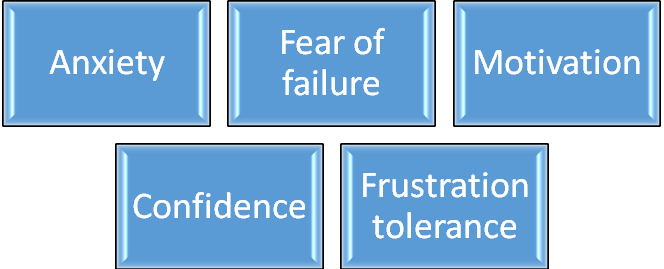
Dynamic assessment also looks at the extent to which emotional factors may impact upon learning. In dynamic assessment, it is possible to explore the extent of these emotional factors and explore if it is possible to change their impact on learning. Some of the emotional factors commonly observed in children during assessment include:
In summary, Dynamic assessment is based on interaction between the assessor and the learner, where the assessor attempts to influence positively the level of performance. The objective is to explore to what extent the learner can respond to assistance and to identify the nature of the assistance that produces the higher level of performance. In this way, specific strategies and ideas can be suggested that may support engagement and learning both in the classroom and at home.
This information has been reproduced from Fraser Lauchlan and Donna Carrigan (2013). Improving Learning Through Dynamic Assessment. Jessica Kingsley Publishers.
Comments are closed.